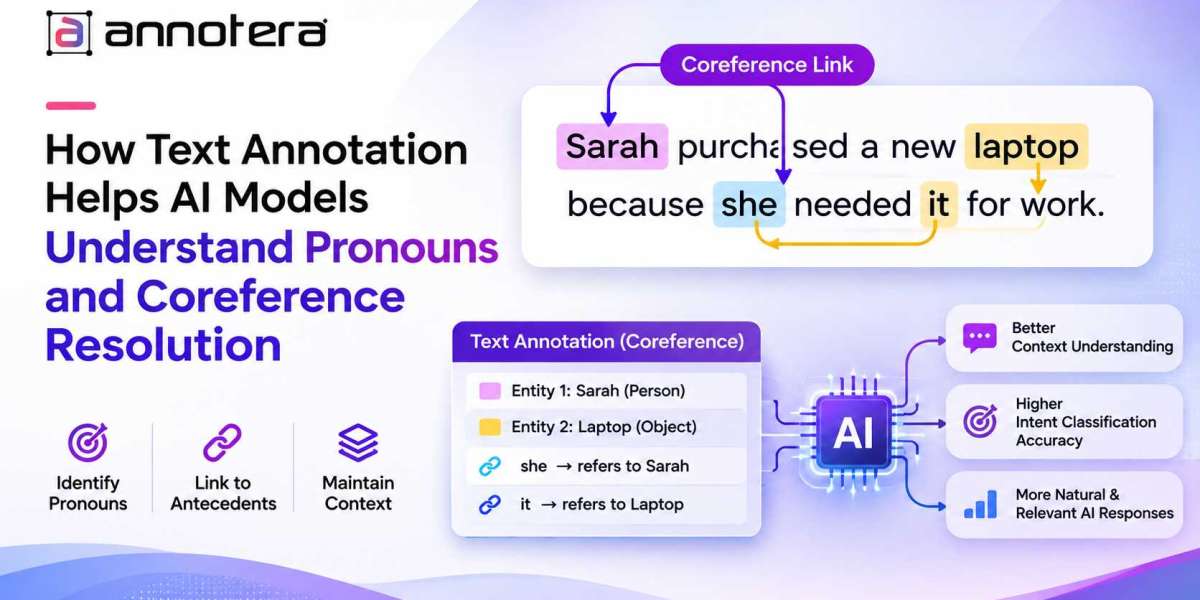

Human communication rarely relies on repeating the same noun or person's name throughout a conversation. Instead, people naturally use pronouns such as "he," "she," "it," "they," and "this" to refer to people, objects, events, or ideas mentioned earlier. While these expressions make conversations more natural and concise, they create challenges for artificial intelligence (AI) systems that must understand the meaning and relationships between words.
For example, consider the sentence: "Sarah purchased a new laptop because she needed it for work." A human reader can easily identify that "she" refers to Sarah and "it" refers to the laptop. However, an AI model must recognize these relationships to interpret the sentence accurately.
This process is known as coreference resolution, an essential Natural Language Processing (NLP) task that helps AI systems identify when multiple expressions refer to the same real-world entity. Accurate text annotation plays a significant role in training models to recognize pronouns, resolve references, and maintain contextual understanding.
What Is Coreference Resolution in Natural Language Processing?
Coreference resolution is the process of identifying different words or phrases in a text that refer to the same entity. These expressions may include proper nouns, common nouns, pronouns, and descriptive phrases.
For instance:
"Michael joined the organization last year. He currently manages its marketing department."
In this example:
"Michael" is the main entity or antecedent.
"He" refers to Michael.
"The organization" represents the company.
"Its" refers to the organization.
An AI model must establish these connections to understand the complete meaning of the passage rather than interpreting each sentence independently.
Coreference resolution is particularly important in conversational AI, virtual assistants, document processing, automated customer support, and information extraction. Without accurate reference identification, AI systems may misunderstand user instructions, retrieve incorrect information, or generate responses that lack contextual relevance.
Why Do AI Models Struggle to Understand Pronouns?
Pronoun interpretation is not always straightforward. The meaning of a pronoun often depends on surrounding sentences, conversational history, and the relationships between entities.
Several challenges make this task particularly complex.
1. Ambiguous Pronoun References
A single pronoun may refer to multiple entities within the same sentence.
For example: "John spoke to David after he completed the presentation."
Here, "he" could refer to either John or David. Without additional contextual information, the intended reference may remain ambiguous.
2. Long-Distance Dependencies
Sometimes, the antecedent appears several sentences before the pronoun. AI models must retain relevant contextual information across longer passages to identify the correct relationship.
3. Multiple Entities in Conversations
Customer support conversations frequently involve several people, products, services, and transactions. Identifying which entity a pronoun represents requires an understanding of conversational context.
4. Implicit References
Expressions such as "this," "that," and "the same one" may refer to previously discussed events, objects, or complete statements. These references require more than simple word matching.
5. Gender-Neutral and Plural References
Models must also understand gender-neutral pronouns, collective references, and plural expressions without making unsupported assumptions about the entities involved.
These challenges demonstrate why high-quality annotated datasets are essential for developing reliable NLP systems.
How Text Annotation Improves Pronoun Identification
Text annotation provides structured linguistic information that helps AI models learn relationships between words and entities. Annotators identify relevant expressions, assign labels, and establish connections that serve as training examples.
Here are the major ways text annotation supports accurate pronoun identification and coreference resolution.
1. Identifying Pronouns and Their Antecedents
The first step involves identifying pronouns and determining the entities they reference.
For example:
"Emma bought a smartphone. She uses it every day."
An annotated dataset may establish the following relationships:
Emma → She
Smartphone → It
These labeled examples teach AI models to associate pronouns with their corresponding entities instead of treating them as unrelated words.
2. Creating Entity-Based Annotations
Entity annotation helps models recognize people, organizations, products, locations, and other important elements within a text.
By combining Named Entity Recognition (NER) with coreference annotation, datasets can establish consistent references across multiple sentences.
For example, "Google announced its latest AI model. The company expects it to improve productivity."
Here, "the company" refers to Google, while "it" refers to the AI model.
Such annotations help AI systems understand how entities are introduced, referenced, and discussed throughout a document.
3. Preserving Context Across Multiple Sentences
Coreference relationships frequently extend beyond individual sentences. Annotators therefore need to examine surrounding paragraphs and conversational history before assigning reference labels.
Context-aware annotation helps models understand whether a pronoun refers to an entity mentioned recently or an earlier subject in the discussion.
This is especially useful for chatbots, virtual assistants, and AI-powered document analysis systems.
4. Handling Ambiguous and Complex References
Not every pronoun has an obvious antecedent. Professional annotation guidelines help annotators identify ambiguous references, distinguish between possible interpretations, and flag cases that cannot be resolved confidently.
This prevents training datasets from introducing incorrect assumptions and improves model performance on complex language patterns.
The Role of High-Quality Annotation in Conversational AI
Coreference resolution is closely connected to other NLP tasks, including entity recognition, sentiment analysis, and intent classification.
Consider a customer support interaction:
Customer: "I purchased a washing machine last week. It stopped working yesterday. Can you help me repair it?"
An AI system must understand that both instances of "it" refer to the washing machine. It must also recognize that the customer's primary intent is to request repair assistance.
Accurate pronoun resolution helps the system interpret the complete request and perform the appropriate action.
This is where structured linguistic datasets become valuable. A reliable text annotation company can develop datasets that combine pronoun identification, entity linking, contextual labeling, and intent classification to support more comprehensive language understanding.
Best Practices for Annotating Pronouns and Coreference Relationships
Building reliable coreference datasets requires consistent annotation standards and quality control processes.
Some important practices include:
Develop clear annotation guidelines: Define how pronouns, antecedents, entity mentions, and ambiguous references should be labeled.
Maintain entity consistency: Assign consistent entity identifiers to all expressions referring to the same entity.
Preserve conversational context: Allow annotators to review sufficient surrounding text before resolving references.
Include diverse language examples: Incorporate different sentence structures, writing styles, domains, and conversational patterns.
Use multi-level quality assurance: Apply expert reviews, inter-annotator agreement checks, and adjudication workflows to resolve disagreements.
Include challenging examples: Annotate ambiguous pronouns, long-distance references, plural expressions, and implicit relationships to improve dataset coverage.
Organizations can also leverage text annotation outsourcing services to manage large-scale annotation projects while maintaining consistent labeling standards and operational efficiency.
How Annotera Supports Better NLP Model Training
Developing AI systems that understand human language requires more than collecting large volumes of text. Training datasets must accurately represent linguistic relationships, contextual dependencies, and variations in human communication.
Annotera supports AI development through structured text annotation services designed to improve the quality and usability of NLP training datasets.
From entity recognition and pronoun identification to coreference resolution and intent classification, Annotera helps organizations prepare context-rich annotated data for conversational AI, intelligent automation, and advanced language models.
With standardized annotation workflows, domain-specific guidelines, and quality-focused review processes, businesses can build more reliable datasets for training and evaluating AI applications.
Conclusion
Understanding pronouns is fundamental to helping AI models interpret human language accurately. Coreference resolution enables systems to connect related expressions, identify entities across sentences, and maintain contextual continuity throughout conversations and documents.
High-quality text annotation provides the structured examples AI models need to learn these linguistic relationships. By combining consistent entity labeling, contextual analysis, and rigorous quality assurance, organizations can develop NLP systems that deliver more meaningful and contextually accurate results.
As conversational AI and language technologies continue to evolve, investing in reliable annotation practices will remain essential. Partnering with an experienced annotation provider such as Annotera can help businesses build scalable, high-quality datasets that support the next generation of intelligent language applications.