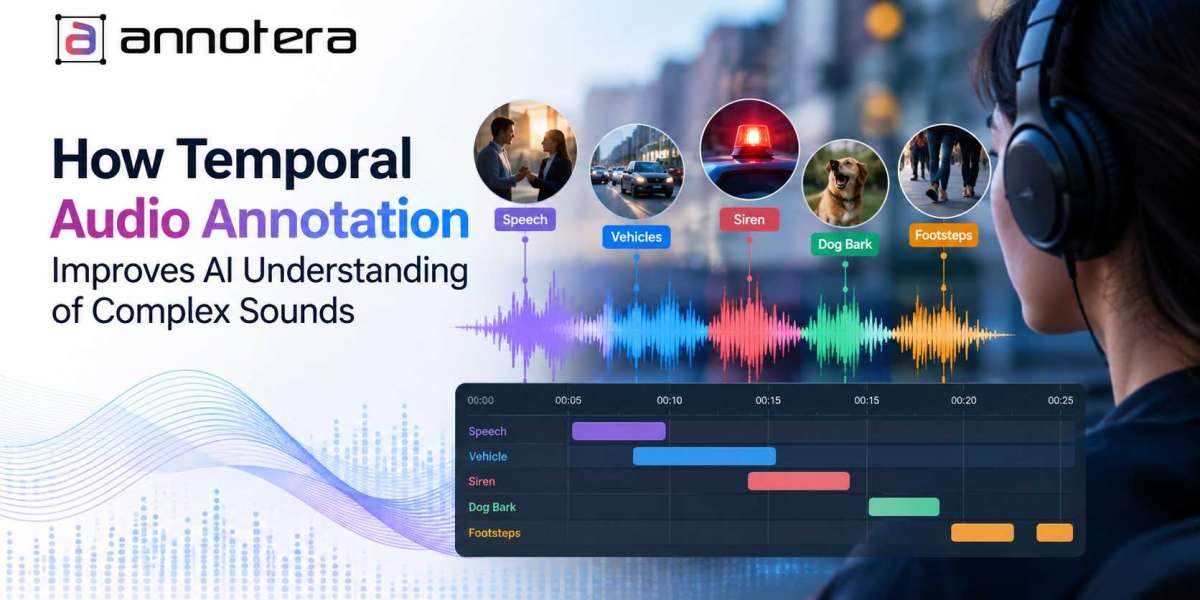

Artificial intelligence is becoming increasingly capable of understanding audio, but recognizing what a recording contains is only part of the challenge. For many real-world applications, an AI system must also understand when a sound begins, how long it lasts, when it ends, and how it interacts with other sounds.
A busy street, for example, may contain speech, vehicle noise, horns, footsteps, construction sounds, and sirens within the same recording. Treating the entire clip as one label does not provide enough information for an AI model to distinguish these events. This is where temporal audio annotation becomes valuable.
Temporal annotation adds precise time boundaries to individual sound events, helping machine learning models learn the relationship between acoustic patterns and their position within an audio sequence. Sound Event Detection (SED), for instance, specifically aims to determine both what sound is occurring and when it occurs.
What Is Temporal Audio Annotation?
Temporal audio annotation involves marking the beginning and ending points of relevant sound events within an audio recording. Instead of simply labeling a 30-second clip as “traffic,” an annotator might identify:
00:02–00:05: Car horn
00:04–00:11: Vehicle movement
00:07–00:15: Human speech
00:13–00:16: Bicycle bell
This creates time-aligned training data that gives an AI model much more context.
The approach is particularly important for Sound Event Detection, where training data typically includes both sound classes and the temporal boundaries of target events. Accurate boundaries help models learn the spectro-temporal characteristics associated with specific sounds.
Why Complex Sounds Are Difficult for AI
Real-world audio rarely consists of isolated, perfectly separated sounds. Multiple events can occur simultaneously, background noise can change continuously, and some sounds may be extremely brief.
Consider an urban surveillance recording. A vehicle may pass while two people are speaking, a horn sounds for less than a second, and construction noise continues in the background. A model trained primarily on clean, isolated samples may struggle to distinguish these events.
Overlapping sounds are particularly challenging because several acoustic sources can occupy the same time interval. Research into sound event detection has therefore focused on systems capable of identifying multiple simultaneous events rather than forcing every moment into a single class.
Temporal annotation provides the structured supervision needed to address this complexity.
1. It Teaches AI When an Event Occurs
A clip-level label can tell a model that a siren exists somewhere in a recording, but it does not tell the model where the siren occurs.
Temporal labels solve this problem by associating an event with a specific interval. During training, the model can learn acoustic characteristics alongside their temporal positions.
This is especially useful for applications such as:
Voice activity detection
Security and surveillance
Industrial monitoring
Smart-city systems
Automotive audio intelligence
Wildlife and bioacoustic monitoring
Call-center analytics
Assistive listening technologies
The result is a model that can move beyond simple audio classification toward more detailed acoustic understanding.
2. It Helps Models Learn Overlapping Events
One of the biggest advantages of temporal annotation is its ability to represent overlapping sounds.
For example, a recording could contain speech from 00:05–00:12 while background machinery continues from 00:00–00:20. A door closing might occur from 00:09–00:10. Each event needs its own temporal representation even though the intervals overlap.
Such annotation allows training datasets to reflect the way sound actually behaves in real environments. Modern sound event detection research explicitly addresses overlapping events and varying temporal granularity because realistic acoustic scenes often contain multiple simultaneous sources.
This can improve an AI system's ability to separate foreground events from persistent or competing background sounds.
3. It Captures Short and Transient Sounds
Some important acoustic events last only a fraction of a second. A keyboard click, glass impact, notification tone, camera shutter, vehicle horn, or warning alarm may be extremely brief.
If annotators label only entire clips, these events can become buried within unrelated audio. Temporal annotation allows such transient events to be explicitly identified.
Precise timestamping can therefore help create datasets for models that need to detect sudden acoustic changes rather than simply classify an entire recording.
4. It Preserves Context Around Sound Events
The meaning of a sound can depend heavily on what happens immediately before or after it.
A short alarm following a machine malfunction may have a different interpretation from the same tone occurring during routine operation. Similarly, speech occurring before a door slam may provide contextual information that helps an AI system interpret the acoustic scene.
Temporal annotation preserves these relationships by positioning events within the broader audio sequence rather than treating each sound as an independent, context-free label.
This becomes increasingly important as AI systems move toward richer audio understanding rather than simple sound classification.
5. It Supports More Accurate Model Evaluation
Temporal annotation also improves how AI models are evaluated.
A system might correctly identify “dog bark” but place it several seconds away from the actual event. For applications requiring real-time detection, that difference matters.
Time-aligned ground truth makes it possible to evaluate not only whether the correct class was detected, but also whether its onset and offset were identified accurately. Research on modern sound detection increasingly considers temporal resolution and event boundaries as important dimensions of evaluation.
This gives development teams a clearer picture of where a model succeeds and where it needs improvement.
Building High-Quality Temporal Audio Datasets
The quality of temporal annotations depends heavily on the annotation guidelines and quality assurance process.
A reliable workflow should define:
Event taxonomy: Establish clear and mutually understandable sound categories.
Boundary rules: Specify how annotators determine the beginning and end of an event.
Overlap handling: Allow multiple simultaneous labels when different sounds coexist.
Background classification: Define how continuous ambient sounds should be treated.
Confidence levels: Capture uncertainty when boundaries or sound classes are difficult to determine.
Quality checks: Review annotations for missed events, incorrect labels, and inconsistent timestamps.
These practices are especially important for datasets containing noisy recordings, multiple speakers, environmental sounds, or acoustically similar events.
Why Audio Annotation Outsourcing Can Help
Creating large-scale temporal datasets internally can require substantial annotation capacity, domain expertise, and quality-control resources. For organizations working with millions of minutes of audio, building and maintaining an annotation workforce may become operationally challenging.
Working with an experienced audio annotation company can provide access to trained annotators and structured quality-assurance workflows. Specialized audio annotation outsourcing services can support temporal segmentation, sound event labeling, speech annotation, sentiment-related labeling, and other audio data requirements at scale.
The right partner can also help organizations establish annotation guidelines, handle difficult edge cases, conduct multi-level reviews, and maintain consistency across large datasets.
The Future of AI Audio Understanding
As AI systems become more capable, understanding audio will require more than recognizing isolated sounds. Models must interpret sequences, interactions, timing, and acoustic context.
Temporal audio annotation provides the foundation for this progression. By connecting sound events to precise moments in an audio stream, it enables models to learn not only what they are hearing, but also when and how those events occur.
For businesses developing speech AI, intelligent surveillance, acoustic monitoring, automotive systems, or other audio-driven technologies, investing in accurately time-aligned training data can make datasets substantially more useful.
Annotera helps organizations build high-quality, structured audio datasets designed for demanding AI applications. With scalable annotation workflows, trained human annotators, and quality-focused processes, organizations can transform complex audio recordings into machine-learning-ready training data.