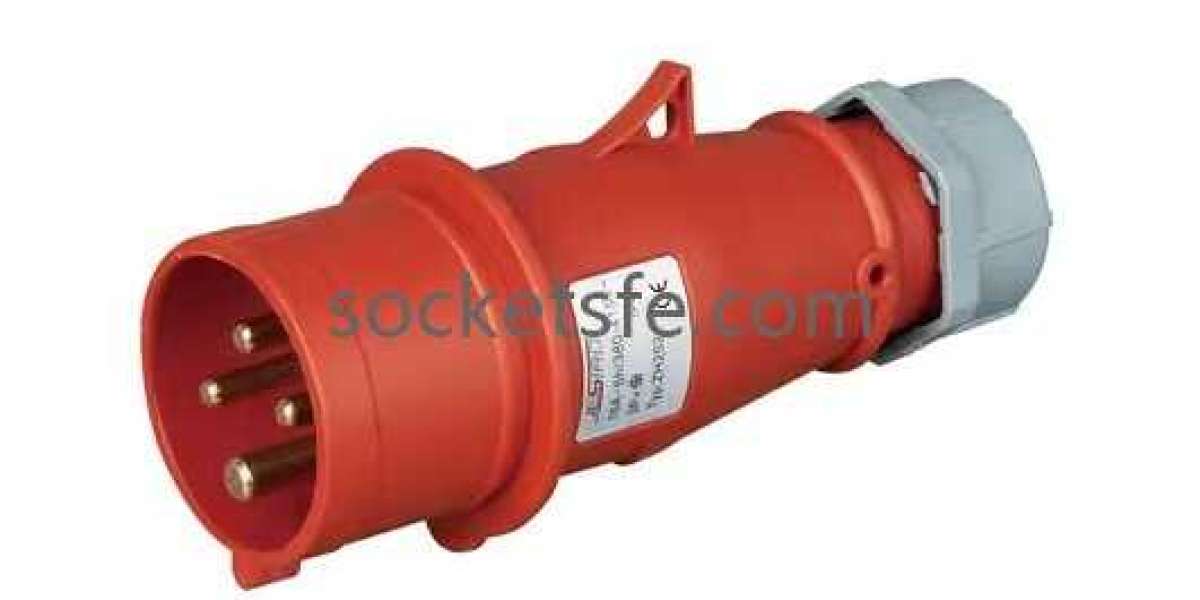

In industrial environments where moisture, dust, and changing working conditions can affect electrical equipment, a Waterproof Industrial Plug is designed to provide a protected interface between a power source and compatible equipment. Its performance depends on more than the external housing. Insulating materials, conductive contacts, sealing structures, cable entry systems, and mechanical retention must work together to create a dependable connection suited to the intended application.
The housing provides the main physical structure of the connector and protects internal electrical components from external conditions. Engineering plastics are commonly used because they can combine electrical insulation with mechanical durability. Material selection may take into account temperature variation, moisture exposure, impact, cleaning chemicals, oils, and other conditions found in industrial workplaces. The housing also needs to maintain accurate dimensions so that internal components and mating surfaces remain correctly aligned.
Sealing technology is a central part of protected connector construction. Seals and gaskets can be positioned around mating interfaces, cable entries, covers, or other potential openings. Their purpose is to reduce pathways through which water and contaminants could reach internal electrical components. Effective sealing depends on the quality of the sealing material, compression, surface condition, dimensional accuracy, and correct assembly.
The cable entry deserves particular attention because the cable itself creates a transition between the protected connector interior and the external environment. A suitable cable-entry structure can help maintain environmental protection while also providing strain relief. Cable diameter and preparation need to match the connector design. Excessive tension, bending, or twisting near the entry point can place unnecessary stress on both the cable and internal termination.
Electrical insulation is another essential component. Insulating materials separate conductive contacts from each other and from the outer housing. These materials should maintain their electrical properties under the environmental conditions for which the connector is intended. Manufacturing accuracy is important because insulation components must maintain suitable separation and support the contacts in their correct positions.
Conductive contacts provide the actual electrical path between the plug and the mating socket. Contact materials are selected according to requirements such as conductivity, corrosion resistance, and mechanical durability. Accurate contact geometry helps establish consistent engagement. Suitable contact pressure can support stable electrical continuity while allowing the connector to be connected and disconnected according to its intended design.
Mechanical retention contributes to both connection stability and environmental protection. Industrial equipment may experience vibration, movement, and repeated handling. A secure locking mechanism helps keep the plug fully engaged with its mating socket. The housing and strain-relief structure should also limit the transfer of mechanical forces to sensitive internal components.
Manufacturing processes influence the consistency of all these features. Plastic housing and insulation components are commonly produced through controlled molding processes. Dimensional accuracy is important for mating surfaces, sealing grooves, locking mechanisms, and contact supports. Conductive components also require controlled forming and assembly so that their final position remains consistent.
Quality control can involve visual inspection, dimensional measurement, electrical testing, mechanical checks, and environmental protection testing appropriate to the connector design. Such testing helps verify that components have been assembled correctly and that the finished connector meets its intended requirements. However, environmental protection classifications are based on defined test conditions, so correct installation remains important when the product is used in the field.
Application conditions should guide connector selection. Factory equipment may encounter moisture from production processes or cleaning operations, while construction machinery can experience dust, rain, and mechanical movement. Outdoor power equipment may face changing weather conditions over extended periods. The connector should therefore be selected according to its electrical requirements, environmental exposure, cable configuration, mechanical conditions, and compatibility with the mating socket.
Installation and maintenance also influence long-term performance. Before connection, users should inspect the housing, seals, contacts, and cable for visible damage or contamination. The plug should be properly aligned and fully engaged with the mating socket. Cable routing should avoid excessive tension and sharp bending. Periodic inspection can identify cracked housings, worn seals, corrosion, loose cable entries, or damaged contact areas.
A properly designed Waterproof Industrial Plug integrates environmental sealing, electrical insulation, conductive contact technology, mechanical retention, and cable protection into a coordinated connection system. These factors help engineers and maintenance teams evaluate connectors according to actual operating conditions instead of relying on a single feature. More information about industrial plug and socket solutions is available at https://www.socketsfe.com, where application requirements, connector construction, environmental conditions, and installation needs can be considered together.